I.C.E. News Release
March 1, 2011
Washington, DC
678 gang members and associates arrested during Project Southern Tempest
ICE makes arrest of 20,000th gang member
WASHINGTON - U.S. Immigration and Customs Enforcement's (ICE) Homeland Security Investigations (HSI) announced today the arrests of 678 gang members and associates from 133 different gangs during Project Southern Tempest, an intensive ICE HSI-led law enforcement operation executed in 168 U.S. cities targeting gangs affiliated with drug trafficking organizations (DTO).
Through Project Southern Tempest, ICE HSI agents worked side by side with 173 of our federal, state and local law enforcement partners to apprehend individuals from 13 gangs affiliated with DTOs in Mexico. More than 46 percent of those arrested during this operation were members or associates of gangs with ties to DTOs.
During this operation, which started in December 2010 and culminated in February 2011, the ICE HSI-led Salt Lake City Operation Community Shield Task Force arrested the 20,000 gang member since inception of the anti-gang program in 2005.
Transnational criminal street gangs have significant numbers of foreign-national members and are frequently involved in human smuggling and trafficking; narcotics smuggling and distribution; identity theft and benefit fraud; money laundering and bulk cash smuggling; weapons smuggling and arms trafficking; cyber crimes; export violations; and other crimes with a nexus to the border.
"Project Southern Tempest is the largest ever ICE-led gang enforcement operation targeting gangs with ties to drug trafficking organizations," said ICE Director John Morton. "Through gang enforcement operations like Project Southern Tempest and Project Big Freeze last year, ICE will continue to disrupt and dismantle these transnational gangs and rid our streets not only of drug dealers, but the violence associated with the drug trade."
"ICE is an important partner in bringing federal prosecutions against dangerous gang members," said U.S. Attorney for the Northern District of Georgia Sally Quillian Yates. "Since Operation Community Shield began in 2005, ICE investigations in our District alone have resulted in numerous indictments against gang members, including charges for seven separate murders, at least five carjackings, several armed robberies and over 40 criminal immigration offenses. The partnership between ICE and our office serves to make neighborhoods stronger and safer by removing and prosecuting criminal gang members."
"By pooling our resources and our intelligence, we've succeeded in taking some very dangerous people off of the streets," said South Salt Lake Police Chief Chris Snyder. "Our goal in partnering with ICE and other law enforcement agencies is to make our cities safer. The gang members and drug dealers targeted in this operation have no regard for the law and their continued illegal activities degrade the quality of life in our communities."
Of the 678 gang members or associates arrested:
they hailed from 133 different gangs;
447 were charged with criminal offenses;
231 were administrative arrests;
322 had violent criminal histories;
421 were foreign nationals.
In addition to the 678 arrests, 164 individuals were arrested for federal and/or state criminal violations, or administrative immigration violations. Of the 164, 117 were charged with criminal offenses, 46 had violent criminal histories, 47 were administrative arrests and 78 were foreign nationals. In addition to the arrests, during the operation agents seized 86 firearms, eight pounds of methamphetamine, 30 pounds of marijuana, one pound of cocaine, more than $70,000 in U.S currency and two vehicles.
Like any street gang, these transnational gangs also have a propensity toward violence. Their members committed a number of violent crimes including robbery, extortion, assault, rape and murder.
Among those arrested during Project Southern Tempest were:
Andrey Melnikov, 36, a Russian national with legal permanent residence status and an associate of the Valleros gang was arrested in Oceanside, Calif., for auto theft. His criminal convictions include possession of weapon on school grounds/carrying loaded firearm public place and felon in possession of a firearm.
Cesar Enrique Barreiro, 27, a U.S. citizen and member of the Lennox 13 gang was arrested in Lennox, Calif., for RICO charges from an ongoing multi-agency investigation. His criminal convictions include for aggravated assault with serious bodily injury. He faces federal criminal prosecution on racketeering charges.
Shawn Allison, 32, a Jamaican national and member of the Jamaican Posse gang was arrested in Bronx, N.Y., for attempted murder. His convictions include possession with intent to distribute and criminal contempt. He faces state criminal prosecution on charges of attempted murder.
Rodimiro Burquez-Cortez, 34, a Mexican national and Surenos gang associate was arrested in Provo, Utah, for re-entry after deportation and narcotics and weapon offenses. His criminal convictions include illegal re-entry; carrying a concealed weapon, assault, DWI, illegal possession of controlled substance, possession of dangerous weapon. He faces federal criminal prosecution for re-entry of previously removed alien, illegal alien in possession of a firearm, and felon in possession of a firearm.
Gustavo Morales, 52, a Mexican national and an associate of the Boomerangz gang was arrested in Reading, Pa., for federal offenses related to narcotics and weapons violations. His criminal history has a conviction for re-entry. He faces federal prosecution for illegal re-entry and narcotics and weapon offenses.
Those arrested came from 24 countries in South and Central America, Asia, Africa and the Caribbean. Of the total number of arrested, 776 were males and 72 were females.
This enforcement operation is part of Operation Community Shield, a global initiative, in which ICE HSI partners with existing federal, state, local and foreign anti-gang efforts to share intelligence on criminal gang organizations and their leadership, share resources and combine legal authorities to identify, locate, arrest, prosecute, imprison and/or deport transnational gang members.
ICE HSI began rolling out Operation Community Shield Task Forces (OCSTFs) throughout the nation as well as in Central America in 2010. There are currently eight OCSTFs in cities including Baltimore; Birmingham, Ala.; Charlotte, N.C.; Dallas; Salt Lake City; San Angelo, Texas; and St. Paul, Minn., as well as one in Honduras. It is these critical partnerships with law enforcement here in the United States and overseas that enables ICE HSI to target a gang's structural leadership and criminal enterprise in the U.S. and in their countries of origin.
Since the inception of Operation Community Shield in 2005, through Jan. 31, 2011, ICE HSI agents working in conjunction with federal, state, local and foreign law enforcement agencies have arrested 20,373 gang members and associates. These apprehensions include 9,590 criminal arrests and 10,783 civil arrests. Of the more than 20,000 arrests, 249 of those arrested were gang leaders, 3,414 were MS-13 members or associates and 7,699 had violent criminal histories. Through this initiative, more than 1,600 firearms have been taken off the streets.
The National Gang Unit within ICE HSI identifies violent street gangs and develops intelligence on their membership, associates, criminal activities and international movements to deter, disrupt and dismantle transnational criminal gang operations by tracing and seizing cash, weapons and other assets derived from illicit activities.
Federal agencies involved in Project Southern Tempest include the FBI; the Drug Enforcement Administration; the Bureau of Alcohol, Tobacco, Firearms and Explosives; U.S. Customs and Border Protection; and the U.S. Marshals Service.
To report suspicious activity, call ICE's 24-hour toll-free hotline at: 1-866-DHS-2-ICE or visit www.ice.gov .
U.S. Immigration and Customs Enforcement (ICE) is the largest investigative arm of the Department of Homeland Security.
ICE is a 21st century law enforcement agency with broad responsibilities for a number of key homeland security priorities. For more information, visit www.ICE.gov . To report suspicious activity, call 1-866-347-2423.
U.S. Dept of Homeland Security
http://www.ice.gov/news/releases/1103/110301washingtondc.htm
Wednesday, March 2, 2011
ICE makes arrest of 20,000th Gang Member!

Sunday, February 27, 2011
Southern Poverty Law Fraud Center
Southern Poverty Law Center Maligns SIOA as "Hate Group"
Photo of the multi-million dollar mansion of Morris Dees, founder of the Southern Poverty Law Center -- how's that exploiting going for ya, Moe? Check out these 60 photos of his multi-million dollar complex (sheesh). Not to mention his perversions and pedophilia (read his divorce papers).
Download Morris_Dees_Divorce_Papers

Over at Steve Sailer's blog:
The Montgomery Advertiser has a 60-photo lifestyle spread on "The home of Morris Dees and Susan Starr in Montgomery, Ala." Mr. Dees is, of course, the founder of the Southern Poverty Law Center, and poverty has been very, very good to him, judging by the staggering amount of expensive bric-a-brac he and Ms. Starr have accumulated.
I'm not precisely sure what Morris' wife is wearing in this photo (Barbarella's coronation gown? Or, as a reader suggests, a shower curtain trimmed with fake fur?), but the caption reads "Susan Starr models a jacket she made in her studio at her home in Montgomery, Ala."
This shiny thing-a-mabob with the #20 on it is described as "A poolside rickshaw at the home of Morris Dees and Susan Starr in Montgomery, Ala," because nothing screams Equality! like a fancy rickshaw.It would probably not occur to you to acquire what might possibly be a matador's outfit to hang next to the washstand in an office bathroom of your compound, but then you aren't the main man behind America's most lucrative poverty organization, now are you?
This white and beigeish picture is described as "Guest house living area at the home of Morris Dees and Susan Starr in Montgomery, Ala.," but the contents remain enigmatic. What exactly is on the coffee table? A nest of writhing snakes? A ton of old horseshoes? And what's that spherical object behind the fuzzy couch? A giant ball of twine?
And then there's this objet d'art. I wonder how much hate Morris had to spew and foment to get the donations to pour in to pay for that?
For some reason, the article accompanying the 60 pictures seems to have largely vanished, but it began:Mediterranean living: Couple’s renovated showplace reflects owners’ world travels, varied tastes
It is hard to believe the home Susan Starr and Morris Dees purchased upon their marriage 11 years ago was once a very small cottage originally built in 1923.Nah, by this point, I can believe anything about Morris.

Many civil rights groups abhor the media whores at the Southern Poverty Law Center, because they exist primarily to raise money and do very little work. It is a spin factory fueling fears of an imaginary white ayran nation, in order to raise money.
Why hasn't the media investigated Morris Dees and his multimillion dollar house?

Above photos: Dees mansh


The Southern Poverty Law Center has been profiled here by Laird Wilcox.
The most troubling aspect of watchdog opportunism is their infiltration of law enforcement. Watchdog organizations feed law enforcement agencies information in order to prompt them to go after their enemies, real and imagined. By alleging “dangerousness” on the basis of mere assumed values, opinions and beliefs, they put entirely innocent citizens at risk from law enforcement error and misconduct.
For example, following the Oklahoma City bombing in 1995 the Southern Poverty Law Center gave the FBI a list of several thousand alleged members of militias and “hate groups” culled from its files. None of them had anything to do with the bombing. These names came from letters to newspapers expressing right-wing political views, lists of “members” supplied by informants, names from license plate numbers collected outside public meetings, pilfered mailing lists, and so on.
The possibility of a mere curiosity seeker or an individual with no criminal intent whatsoever being suggested to the FBI or BATF as “dangerous” seems inevitable. Along these lines, watchdog influence on law enforcement policies in tragedies from Ruby Ridge to Waco needs to be examined in detail.
[T]he Southern Poverty Law Center’s use of civil law to accomplish defacto criminal prosecutions without the benefit of appropriate constitutional guarantees, is simply wrong, and would be wrong no matter who did it. The rules of evidence and procedural practices in criminal cases are far more protective of civil liberties than those civil cases.
In civil prosecutions, for example, a defendant is not entitled to legal counsel unless he can pay for it, whereas in criminal prosecutions legal counsel is guaranteed, regardless of ability to pay. It has not gone unnoticed that most of the defendants in civil cases brought by the Southern Poverty Law Center are either indigent or of very modest means.
In February 1992 USA Today reported that Klanwatch, a division of Morris Dees’ Southern Poverty Law Center, had identified a total of “346 white supremacy groups operating in the USA, up an alarming 27% from the past year.” Included were 97 Ku Klux Klan and 203 alleged neo-Nazi groups.
What Klanwatch apparently did was list any group they could find mention of, including groups only rumored to exist. These included the large number of “post office box chapters” maintained by Klan and skinhead organizations. Some Christian Identity “ministries” consist only one person and a mailing list and many “patriot groups” consist of but three or four friends.
They also listed many groups whose actual affiliation is neither KKK nor neo-Nazi and who would argue with the designation of “white supremacy.” In short, they misleadingly padded their list.
A good example of SPLC disinformation occurred in June 1998 when SPLC spokesman Mark Potok responded to a newspaper request for background information on three accused cop killers. According to news reports
Alan “Monte” Pilon, one of the men suspected of killing a Cortez police officer and wounding three other officers, is a member of a local militia group linked to an extreme right-wing religion, a militia expert said Thursday.
Pilon, 30, of Dove Creek, is a member of the Four Corners Patriots, according to
Mark Potok, spokesman for the Southern Poverty Law Center, a nonprofit organization that monitors hate groups. The Four Corners Patriots is an underground militia linked to the Christian Identity religion, a faith Potok described as “viciously racist and anti-Semitic.
Potok further claimed to have been tracking the group since 1995 and estimated the group had 25 members. These claims, along with this detailed information, clearly gives the impression that the SPLC knows what it’s talking about. Potok’s claims were picked up by wire services and repeated nationwide, including NBC Nightly News with Tom Brokaw
One small problem: There apparently is no “Four Corners Patriots” organization. It doesn’t exist. Nobody in the broader militia and patriot movement had ever heard of them. My own efforts to pin down the organization were without success. Even local law enforcement couldn’t vouch for their existence and no evidence has developed that any of the suspects ever belonged to a militia organization.
The interplay between the SPLC and the media that depends upon them for information is complex and corrupt.
In February 1994 the Montgomery Advertiser ran a series of articles exposing various aspects of the SPLC, including its highly questionable fundraising tactics. In 1993, the American Institute for Philanthropy ranked the Southern Poverty Law Center as the “fourth least-needy charity in the nation.” Among the issues raised were:
The SPLC has reserve funds of $52 million...Just what the Law Center does with all that money is a source of concern. Some who have worked with Morris Dees call him a phony, the ‘television evangelist’ of civil rights who misleads donors...
For 15 years, people throughout the country have sent millions to the (SPLC) to fight the Ku Klux Klan and other supremacists. But critics say the law center exaggerates the threat of hate groups...
The American Institute of Philanthropy rates charitable institutions according to several criteria, including percent of income spent on charitable purposes, excess assets and so on. The Southern Poverty Law Center was rated “F” on a scale A through F. By way of comparison, the ACLU Foundation was rated A- and the Anti-Defamation League was rated B+.
Morris Dees [founder of the Southern Poverty Law Center] has been married four times, and in an appellant brief filed by Maureene Bass Dees in their acrimonious 1979 divorce she alleges numerous infidelities, homosexual behavior and a sexual interest by Morris Dees in both his adolescent stepdaughter and his daughter-in- law.
In all fairness, accusations and claims made in a divorce case may or may not be reliable. However, one must also ask how reliable are depositions, affidavits and testimony made by limited-income Ku Klux Klansmen who cannot afford legal counsel when faced with possible civil or criminal charges by Morris Dees. How many have agreed to say what Dees wanted them to say just to survive? How many legal “victories” have been obtained in this manner? Morris Dees and the SPLC must be judged by the same standards they have used to judge others.
Writing in a June, 1998, issue of The Nation, a leftist weekly, writer Alexander Cockburn observed:
"Morris Dees has raised an endowment of close to $100 million, with which he’s done little, by frightening elderly liberals that the heirs of Adolph Hitler are about to march down Main Street, lynching blacks and putting Jews into ovens. The fundraising of Dees and the richly rewarded efforts of terror mongers like Leonard Zeskind offer a dreadfully distorted view of American political realities."
For further reading -
Ken Silverstein, “The Church of Morris Dees: How the Southern Poverty Law Center Profits from Intolerance,” Harper’s Magazine (November 2000), 54-57.
Dan Morse, “Marketing the Klan,” Montgomery Advertiser (November 1994)
John Edgerton, “Poverty Palace: How the Southern Poverty Law Center got rich fighting the Klan,” The Progressive (July, 1988)
Declairing Pamela Geller's group a "hate group" is politically motivated defamation. Please help set the record straight on this
Roland Shirk opines:
I might be forced to adopt a rather cynical reading of SPLC's motives. A group that began as Klan Watch, back when the Klan still (barely) existed, SPLC has since had to reinvent itself as an all-purpose watchdog keeping a keen eye on the activities of groups such as... Civil War Reenactors, Catholic monks, and opponents of Islamic terror. Given the happy decline into obscurity of white racist and anti-Semitic groups (anti-Zionists don't count, no matter how many Jews they kill), SPLC has been forced to look a little harder for its targets. Since the only people outside of psych wards and tiny little compounds in Idaho who still preach the mass repression or murder of others based on religion are Muslims, and are by definition innocent, the standards for what makes a hate group will have to broadened a bit.
The alternative is too ugly to contemplate: SPLC might have to declare “victory” and go home, and its officers might have to sacrifice the six-figure incomes they earn by churning out letters that scare elderly Holocaust survivors into writing them fat checks. That money might instead be wasted on legacies to their grandchildren, when it could go to good use gold-plating the toilet fixtures on SPLC's glittering Poverty Palace. Men like Morris Dees would have to find jobs at Starbucks.
Without the SPLC to tell us where to locate intolerance and bigotry, we might find ourselves confused. We might look at foundations which funnel money into foreign terrorist organizations devoted to murdering Jews and Christians, and mistake these charities for hate groups. We might, when we read about blasphemy laws that target religious minorities, or social mores that goad fathers into murdering their daughters, somehow conclude that the creed which underlies such activities is in itself hateful. And that might lead us to assert our country's native values—driving us thereby down the ugly road of nativism.
The Lid: Soros Funded Hate Group Uses Terrorist Org. Support to Brand Pamela Geller as Racist
Mark Potok, Chief SPLC Hatemonger
Monday, February 14, 2011
1 eth by land 18 by Sea
CBP U.S. Border Patrol Stops North County Maritime Smuggling Attempt
(Monday, February 14, 2011) San Clemente, Calif. — Today, California National Guard troops supporting the U.S. Border Patrol assisted in the arrest of 18 Mexican nationals on the coastline of San Onofre State Park early this morning after they were smuggled into the country by boat.
At approximately 5:30 a.m., guardsmen assigned to pre-designated detection sites along the southern California coastline spotted a person on an oceanfront cliff in San Onofre State Park scanning the water with a flashlight. CNG observed a panga style boat travelling eastbound toward the shoreline, and alerted Border Patrol agents assigned to the north county Coastal Border Enforcement Team.
Agents observed several individuals disembark from the beached boat and run to the nearby cliffs. Agents responded and encountered a total of eighteen individuals hiding along the cliffs. The group of 14 males, one female, and three juvenile males were determined to be Mexican nationals who had entered the U.S. illegally.
The Mexican nationals were arrested and transported to a local Border Patrol station for processing and further investigation. Agents identified two of the arrested individuals as being responsible for the smuggling attempt. They are being held in federal custody pending prosecution for alien smuggling. The boat was seized by the U.S. Border Patrol.
Friday, February 11, 2011
Agents Foil Smugglers, Nab More than $5.7 Million in Dope
(Tuesday, February 08, 2011)
Edinburg, Texas - Although the Rio Grande Valley was thawing out from abnormally cold temperatures, that didn’t stop U.S. Border Patrol agents from putting the freeze on smugglers’ efforts to get more than 7,000 pounds of marijuana across the border over the past three days.
Marijuana Seized by Rio Grande Valley Sector
The largest seizure occurred Friday in Fronton, Texas, when agents assigned to the Rio Grande City Station saw a Ford pickup truck drive down to the Rio Grande. When the truck arrived at the riverbank, several people began throwing bundles of marijuana into its bed.
Once the pickup was loaded, it was driven away from the river at a high rate of speed. Agents used a controlled tire deflation device and deflated three of the vehicle’s tires. Agents found the pickup nearby at an abandoned house.
2,300 lbs. Marijuana Seized by Border Patrol Agents in Rio Grande City
As agents searched the area, they noticed the front door to the abandoned house was open and could see large bundles of marijuana inside. In the bed of the pickup and inside the house agents found more than 2,300 pounds of marijuana, with a value of more than $1.8 million.
In total, from Friday to Sunday, agents from the Rio Grande Valley Sector seized more than $5.7 million in marijuana. The drugs were turned over to the Drug Enforcement Administration.
To report suspicious activity, call the Rio Grande Valley Border Patrol Sector’s toll-free telephone number at 800-863-9382.
U.S. Customs and Border Protection is the unified border agency within the Department of Homeland Security charged with the management, control and protection of our nation's borders at and between the official ports of entry. CBP is charged with keeping terrorists and terrorist weapons out of the country while enforcing hundreds of U.S. laws.
Busy Weekend for CBP Officers in San Diego, Imperial Counties
(Wednesday, February 09, 2011) San Diego — U.S. Customs and Border Protection officers at the ports of entry between California and Mexico were busy this weekend, stopping 652 pounds of narcotics worth almost an estimated $2.5 million.
CBP officers in the San Diego Field Office on Saturday and Sunday stopped approximately 467 pounds of marijuana, 147 pounds of cocaine, 29 pounds of methamphetamine, and almost 9 pounds of crystal methamphetamine, or “ice." The San Diego Field Office encompasses the San Ysidro, Otay Mesa, Tecate, Calexico, and Andrade ports of entry, as well as airport and seaport activity in San Diego.


CBP officers found 62 packages of marijuana in this engine compartment, weighing 168.5 pounds
The largest narcotic seizure took place at about 8:15 p.m. on Saturday, February 5 at the San Ysidro port of entry, when a 36-year-old male U.S. citizen drove a blue 1992 Chevrolet Silverado to the border crossing. A CBP officer roving through the lanes of waiting traffic screened the vehicle with a narcotic detector dog, and the canine alerted. CBP officers escorted the vehicle and driver for a more intensive inspection.
During the inspection, CBP officers found 62 packages wrapped in cellophane, packaging tape, and grease/oil under the vehicle’s hood, containing 168.5 pounds of marijuana. CBP seized the vehicle and narcotics and turned the driver over to U.S. Immigration and Customs Enforcement agents.
CBP stopped more than 175 immigration violators at the ports of entry this weekend, including people with counterfeit or altered documents, imposters to legal documents that do not belong to them, and persons hiding to try and avoid inspection when entering the United States.
In one incident at the Otay Mesa port of entry at about 7:10 p.m. on Saturday, a 27-year-old male Mexican citizen arrived at the Otay Mesa port of entry pedestrian processing area. The man did not provide any documentation, but orally claimed to be a U.S. citizen and the CBP officer referred him for further inspection.
Using fingerprint identification, CBP officers confirmed the man’s identity and that he is not able to legally enter the United States.
Later on Saturday at the same port of entry, at about 11:30 p.m., a 37-year-old male Mexican citizen driving a white Ford Mustang arrived at the Otay Mesa passenger port of entry. The driver presented a valid resident alien card, but the CBP officer suspected that he was not the true legal owner of the card.
CBP officers confirmed that the card in fact belonged to the driver’s older brother, and that the driver is not able to legally enter the United States.
Also this weekend, CBP officers stopped 13 fugitives with active arrest warrants.
CBP officers enforce hundreds of laws at the ports of entry into the United States, including not just immigration and customs laws, but also agriculture laws.
In one incident on Saturday, at about 8:30 a.m., a 46-year-old male Mexican citizen with a valid border crossing card arrived at the Tecate port of entry. The man was applying for an I-94 permit, required for Mexican visa holders with a border crossing card to travel beyond 25 miles from the border.
During his inspection, CBP officers found 77 pounds of undeclared pork tamales. The man paid a $175 civil penalty and was released. CBP seized and destroyed the pork products.
Tuesday, February 8, 2011
Drug smugglers caught on tape 35 miles north of U.S. border
- February 7th, 2011 8:51 am PT
A weekend video clip posted by Arizona Border Defenders shows six drug cartel mules (lackeys that transport drug-laden backpacks) carrying loads of marijuana more than 35 miles north of the U.S./Mexico border.
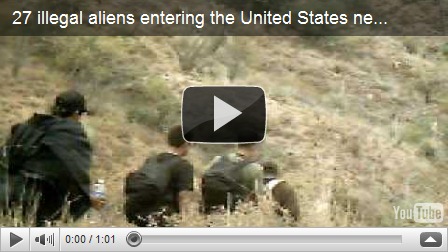
Arizona Border Defenders is a patriot group dedicated to exposing the porous southern borders by using hidden video cams throughout the region in order to document the hoards of illegal traffic flowing north into the country.
While a great many of these illegal aliens are seeking a better life for themselves or their family, drug cartels are also using the smuggling routes to transport drugs often making for a dangerous trek.
There are several reports of illegal aliens being robbed, beaten or raped by desert bandits preying on unsuspecting migrants who are walking through the harsh terrain.
The brief hidden camera video clip points to the risky side of passing through the desert at night. Many of these drug smugglers will use violence if anyone threatens their ability to transport their illicit drugs to a hungry U.S. consumer.
These well-placed hidden cameras provide a birds-eye view of just how dangerous the southern-border region remains and prove America’s borders remain unsecure.
Thanks to the Arizona Border Defenders for this great Video
Continue reading on Examiner.com: Drug smugglers caught on tape 35 miles north of U.S. border - San Diego County Political Buzz | Examiner.com http://www.examiner.com/county-political-buzz-in-san-diego/drug-smugglers-caught-on-tape-35-miles-north-of-u-s-border#ixzz1DOYeDgr8
Border Patrol snares 31 illegal aliens along San Diego coastline
- February 7th, 2011 7:33 pm PT
U.S. Border Patrol agents arrested 31 illegal aliens yesterday who tried to unlawfully enter the country aboard small, panga-style boats off the San Diego coastline.
Just after midnight, Border Patrol agents, working in conjunction with CBP Air and Marine Branch, spotted a panga boat cross the U.S. international boundary and travel north along the California coast.
The vessel came ashore near the mouth of the Tijuana River, several individuals disembarked and then the boat quickly returned south towards Mexico. Border Patrol agents wasted no time and apprehended 14 individuals and placed them under arrest for unlawfully entering the United States.
According to CBP, two female and 11 male Mexican nationals as well as one male Honduran national were transported to a local Border Patrol station for processing.
“A second maritime smuggling attempt was intercepted this morning near Camp Pendleton, California. At approximately 2:50 a.m., Border Patrol agents observed a panga-style boat approach the shoreline near Red Beach. Several individuals jumped out of the boat and headed toward cliffs east of the shoreline,” a CBP statement read.
Border Patrol agents quickly responded to the scene and arrested 17 individuals who all claimed to be Mexican nationals illegally entering the United States. Agents transported 13 males and 4 females to a local Border Patrol Station for processing.
However the boat absconded back toward Mexico, before agents could reach the location.
With the deployment of the National Guard along the California coast, CBP and Border Patrol have been able to hone their nighttime observation skills and been able to foil many daring maritime entries into America along the Southern California coast.
For more stories; http://www.examiner.com/county-political-buzz-in-san-diego/kimberly-dvorak
Continue reading on Examiner.com: http://www.examiner.com/county-political-buzz-in-san-diego/border-patrol-snares-31-illegal-aliens-along-san-diego-coastline#ixzz1DOWfNJZ3